It is January 2026. Most supply chain organizations finally have what they spent a decade chasing: near-real-time visibility across demand, supply, and logistics.
Yet, for many, performance gaps are widening.
The crisis isn’t technological; it’s behavioral. In my experience operating inside complex global networks, visibility rarely fails anymore. Decision latency does. Dashboards light up, risks are flagged early, and then… the system grinds to a halt. We schedule meetings to discuss the alerts. We debate ownership. We run manual scenarios long after the window for cost-effective action has closed.
By the time the “Execute” button is pressed, the damage is already on the books.
The Hidden Tax of Hesitation Decision delays don’t appear as a line item, but they leak through the P&L in three specific ways:
- Premium Freight as a Default: Planned shipments turn into expedites because the “go” signal sat in an inbox for 24 hours.
- Working Capital Traps: Inventory becomes the “buffer for indecision.” We carry safety stock not to protect against market volatility, but to protect against our own slow response times.
- The Trust Deficit: Customers don’t care about your internal alignment meetings. They feel your reactivity. In 2026, predictable execution is the only thing that builds loyalty.
From Reporting to Reasoning: The AI Shift. Most AI deployments are still stuck in “Reporting Mode,” telling you what happened or what might happen. That is necessary, but insufficient.
The real value of AI in 2026 is Uncertainty Compression. AI shouldn’t just flag a delay; it should provide a probability-weighted cost impact and three executable options. This gives leaders the confidence to act earlier with imperfect data.
The Agentic Edge: Removing the Human Bottleneck This is where Agentic AI changes the game. While traditional AI suggests, Agentic systems act within predefined guardrails.
- They don’t wait for a Monday morning meeting to reroute a delayed shipment.
- They don’t ask for permission to rebalance inventory when a threshold is breached.
- They execute at machine speed, leaving humans to focus on high-level strategy and risk tolerance.
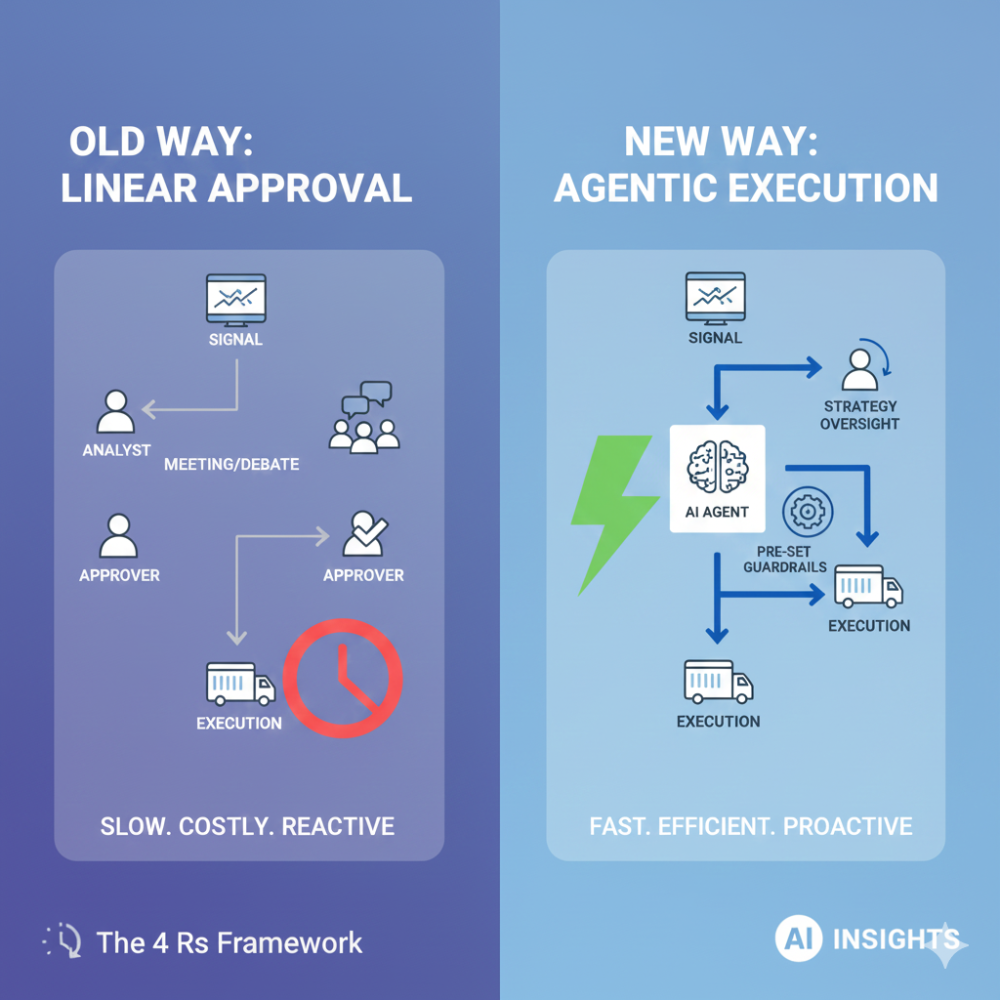
The 4 Rs Framework: A Blueprint for Velocity Speed without structure is just chaos. To turn velocity into a discipline, I use the 4 Rs Framework:
- Recognize: Use signal-driven monitoring to catch deviations instantly.
- Reason: Use AI to weigh cost vs. service trade-offs in seconds, not days.
- Respond: Empower “Autonomous Nodes” to act within set authority limits.
- Reinforce: Feed the results back into the model to accelerate the next cycle.
The Bottom Line In 2026, Decision Velocity is no longer an operational “nice-to-have.” It is a financial discipline.
Visibility shows you the problem. Decision velocity determines who wins. If your organization is still debating signals while your competitors are executing on them, you aren’t just slow; you’re becoming obsolete.
Related Reading
- Why Supply Chain Resilience Requires Better Decision Rights
- The Biggest Financial Risk in Your Supply Chain
The views and opinions expressed are those of the author/s and do not necessarily reflect the official policy or position of companies or clients for whom the author/s are currently working or have worked. Any content provided by the author/s is of their opinion and is not intended to malign any religion, ethnic group, club, organization, company, individual, or anyone or anything.